Solo
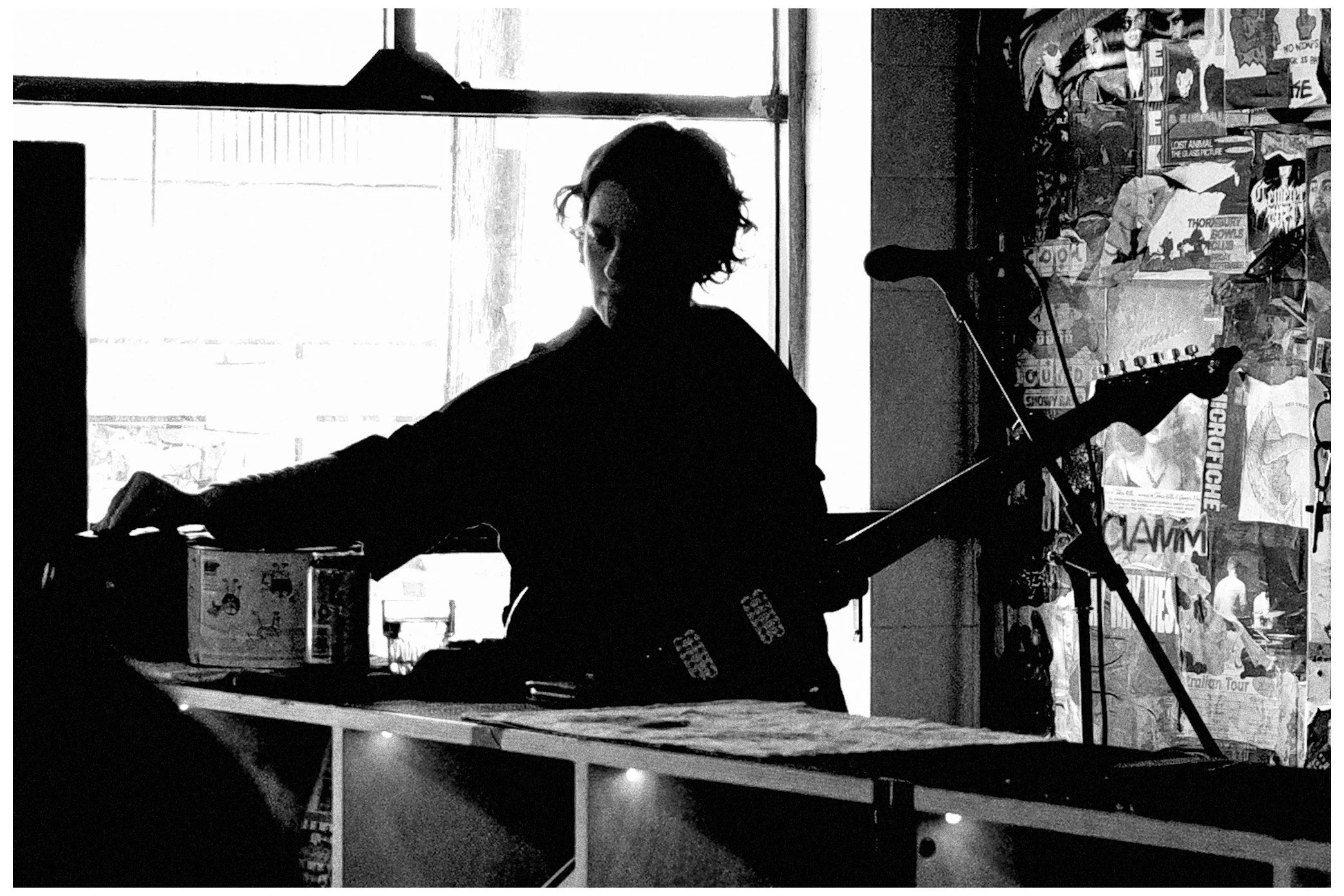
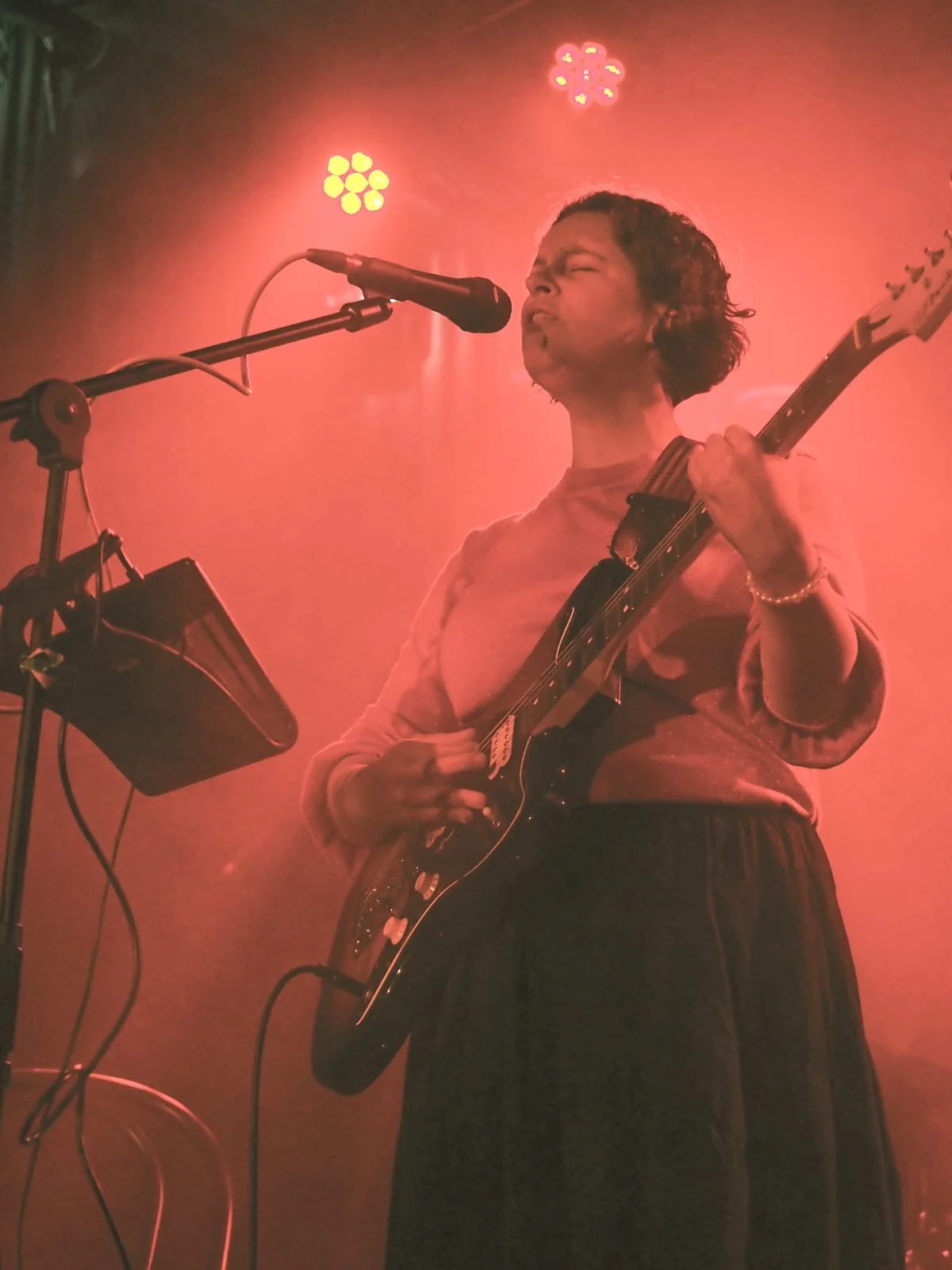
As a solo improviser Laura works primarily with clarinet, feedback, objects, voice and place.
She also writes and performs songs with voice and guitar, and occasional other elements.
Laura’s compositional practice includes writing and arranging for ensembles, as well as crafting and collating exploratory audio works.
These practices are sometimes distinct from each other, and sometimes find themselves blurring and informing each other.
Solo CD release: Holy Trinity (Relative Pitch Records)

Holy Trinity is Laura’s first solo CD release
Relative Pitch Records (2025)
clarinet, speakers, tapes, tins, voice, small collected objects
Reviews
(auto-translated from French) … With headphones on, I fall in love with these sounds; I'm immersed in the beautiful reverb of the Anglican church of Holy Trinity in York … This clarinetist's sensitivity combines with her incredible creativity. She plays for herself, she plays for us, not only the clarinet, in what appears to be a unique position ('Altman's exploratory practice '), but also manages to incorporate and arrange cassettes, various objects, and speakers, bringing us yet other sonic universes: lost birds, the whistling of warm but unsettling wind, the clatter of water droplets, noises as serene as they are disturbing... The recording is magnificent, the disc resonates, it even shines, the silences are ever-present, we are serenely bathed in a kind of light ether, as touching as it is all-encompassing. Immersive in the modern sense. Immersive and even strangely captivating. - Valery John Klebar, STNT
Laura Altman’s Holy Trinity weaves melodic tinctures permeated with interesting sonic textures; her tone is solemn but like a warm blanket that continually covers the cracks and wraps itself around us. A voice emerges from shadows, barely there but glowing, creating soft environments and delicate echo chambers. The cadences are irregular and sometimes sharp, but the semblances of structure give the ghostly nature of this music something to dance around. Each piece feels like discovering something fragile that’s been waiting in the quiet all along. - Brad Rose, Foxy Digitalis, The Capsule Garden Vol 5.1
Laura Altman's Holy Trinity takes its name from the Anglican church in Western Australia where it was recorded. It doesn't seem directly concerned with that classic trio of Father, Son, and Holy Spirit, but as I read the label's notes about the release, they offered up another apt trinity in the context of Altman's solo improvisational practice: instrument, environment, and intervention. I'd like to slightly complicate that last one. Let's say: int(erv)ention, the hazy crossroads of intention and intervention, that wavering boundary between what you put into the world and how the world meets it.
I first encountered Altman's clarinet along with accordionist Monica Brooks and piano-deconstructionist Magda Mayas in the brilliant improvising trio Great Waitress. Altman's solo work shares many of the same concerns: multiple sound sources converging in new timbres, emergent phenomena from the layering of overtones, the use of gaps and silences to emphasize or regather. Rather than responding to bandmates, on Holy Trinity Altman positions her clarinet, voice, and small objects like tin cans in dialogue with more contingent forces—some environmental, some of her own devising—fragile and volatile feedback from a small amplifier, tape interjections from handheld cassette players, reflections and distortions of reverberant space, birdsong in the churchyard.
The starting and ending tracks "Opening Out" and "Turning In" do well to describe the dual aspect of the music, a double movement of eruption and irruption, Altman unfolding her sounds into the receptive room and enfolding those it gives back. She works in pure, swelling tones, often alternating between registers to create slowly pulsing cycles of low and high, pushing into altissimo notes that seem on the cusp of existence and at the edge of control, as frail as the feedback she duets with. Tracks like "A Call to Water" and "The Song I Came to Sing" trouble the boundaries between clarinet or voice or speaker, delicate ecosystems of sound that cloud agency and confound temporal order. This causal erosion seems to float things off into an incorporeal realm of sound-in-itself, and yet there's a forceful grounding element that is always present, a strong feeling of embodiment and place, Altman's inward breaths the caesurae punctuating the overlapping resonances—that palpable, vibrating air within Holy Trinity.
In a remarkably harmonious passage, Barry Blesser once wrote of a clarinet note sounding in a cathedral which could be thought of as "a million bells, each with its own pitch, and each with a slightly different decay rate," the clarinet exciting those reverberating frequencies such that "you are actually hearing the bells of space." As I'm listening to Holy Trinity, I'm hearing Altman's patient exploration, offering and accepting in return, ringing variously the sacred bells of space. This may not be devotional music, but it still feels like an exaltation. - Dan Sorrells, The Free Jazz Collective


Other solo work:
Live at Woollahra Gallery (2023)
Excerpts on soundcloud (2018)
Exquisite Excursions… (2011)
other compositional work
Live Review:
“Sitting between electronic processing and acoustic improvisation was Sydney clarinettist Laura Altman, who records her wistful, lightly muted sounds on small microphones placed beneath cans and other resonant objects, signal from which is then fed into cassette tapes whose playback is picked up again. Lovingly manipulating these devices with her feet while cupping her clarinet’s mouth against her thigh, this was a wonderfully corporeal work of gentle feedback, metallic buzzes and stop-start, warbling, acoustic noises.”
Review from Audible Edge Festival, Perth 2019 - Limelight Magazine